
Chai Tycoon is our own game: a 3D arcade idle game for Android in which you start with one stove at a roadside tapri and grow it into a chain of ten shops. Its tagline is "Ek chhoti si tapri se chai empire tak!" It is coming soon to Google Play. We built all of it ourselves, from gameplay and economy to art, backend and billing. This post is about the design problems a game like this poses, and how we approached them.
What is Chai Tycoon?
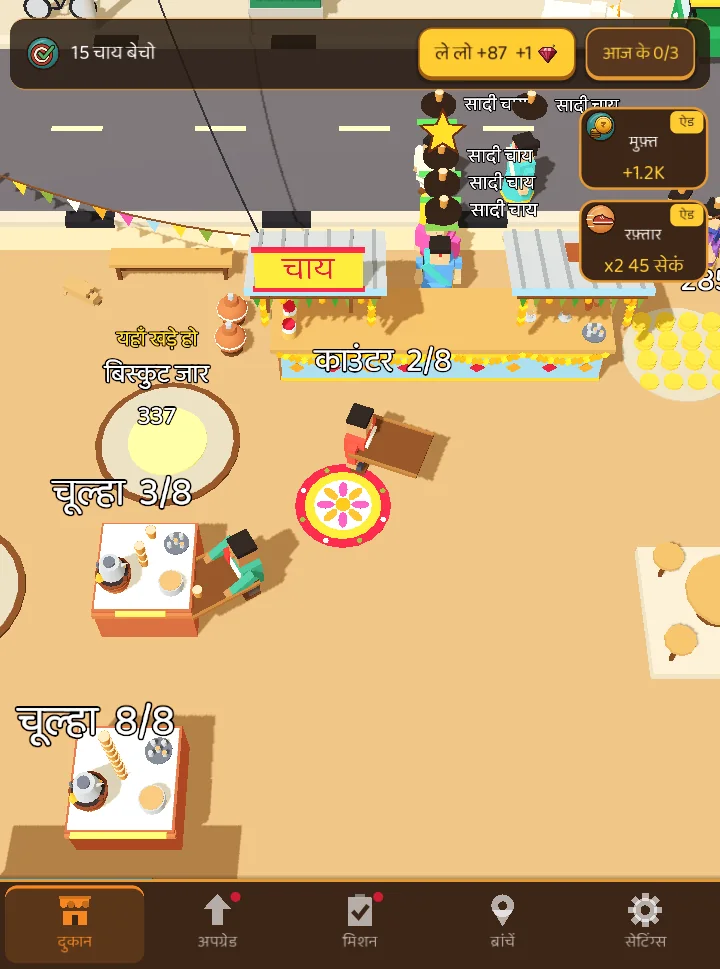
Chai Tycoon is a free-to-play idle game where you brew and serve chai, then hire staff and open new branches. You drag to run, fill your tray at the stove and stock the counter before the queue loses patience. Coins buy more stoves, new products and tables, where seated customers leave tips. Servers keep things moving, and a manager can run a whole shop so you can move on to the next one.
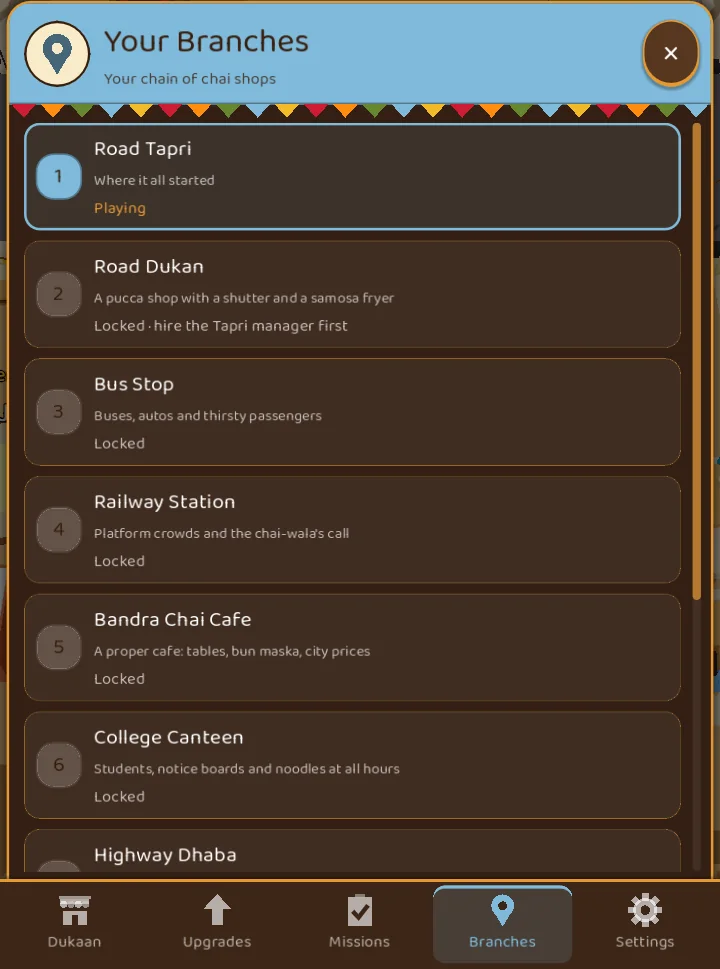
The chain has ten shops, each with its own look and missions:
- Road Tapri
- Road Dukan
- Bus Stop
- Railway Station
- Bandra Chai Cafe
- College Canteen
- Highway Dhaba
- Mall Food Court
- Airport Lounge
- Five-Star Hotel Lobby
Across them there are 8 products on the menu and 80 variants to collect, starting from Adrak Chai.
Why did a software studio build its own game?
We built Chai Tycoon because a game exercises almost every skill a software studio needs at once: a fast, responsive interface, a careful economy, a backend with logins and payments, and an app that has to run well on ordinary phones. [TODO: owner to add the personal reason or moment the idea started, if they want to share it]
How do you make a game playable with one thumb?
You make a game playable with one thumb by giving the player one main action and letting the game handle the rest. In Chai Tycoon that action is dragging to move. Picking up chai, filling the tray and serving happen when you walk to the right spot, so the player never has to hunt for small buttons in the middle of a rush.
The problems we had to solve here are common to every mobile arcade game:
- Keeping buttons large and out of the area the thumb covers while moving.
- Making the camera follow the player without causing motion sickness or hiding customers.
- Reading clearly on small screens, in both Hindi and English text.
How do you keep a 3D game smooth on low-end phones?
By offering a lighter quality mode for low-end Android phones. Chai Tycoon is built in the Godot engine, and it includes a lighter graphics mode so it stays playable on less powerful devices. Many players in India use budget phones, so treating them as an afterthought was not an option. [TODO: other tools used for 3D art, animation and audio]
How do you balance an idle game economy?
You balance an idle economy by modelling it before players ever see it. With 8 products, 80 variants, upgrades, staff and ten shops, every price and every earning rate affects every other. If upgrades are too cheap, the game ends too soon. Too expensive, and players stall and leave.
We tested the economy with our own balance simulator: a tool that plays through the progression with given prices and rates, so we can see where the pace drops or jumps before tuning it by hand. The questions it helps answer are the ones any idle game has to face:
- How long does it take to afford the next meaningful upgrade?
- When should a new shop unlock, so the player is excited rather than bored?
- How much do tips, servers and managers change the pace?
- Does a player who never pays still progress at a fair speed?
[TODO: one concrete example of a balance problem the simulator caught, if the owner wants to share it]
How do offline earnings work without being abused?
Offline earnings mean your shops keep earning while you are away, and the reward has to be generous enough to welcome players back but hard to cheat. A common trick in idle games is to change the phone's clock to fake time passing, so offline earnings should not trust the device alone.
Chai Tycoon has its own backend for login, cloud saves, the in-game wallet and analytics, and it supports offline play. Balancing those two, playing without a connection while keeping progress and wallet trustworthy, is one of the harder problems in any game like this. [TODO: how offline earnings are calculated and capped, in player-friendly terms]
What does it take to support Hindi and English?
Supporting Hindi and English takes more than translating a list of words. Every piece of on-screen text has to be stored separately from the game logic, fonts must render Devanagari correctly, and layouts must handle text that is longer or shorter in one language. The tone also matters: a chai stall game should sound like the street, not like a textbook, in both languages.
Version 2.0 of the game is in eight languages: English, Hindi, Bengali, Marathi, Telugu, Tamil, Malayalam and Punjabi. [TODO: how translations were written and reviewed]
How do you balance ads and in-app purchases fairly?
You balance ads and purchases fairly by making both optional and keeping the free game complete. Chai Tycoon is free to play, with rewarded ads that players choose to watch for a bonus, and optional in-app purchases.
| Approach | What it means for players |
|---|---|
| Rewarded ads | The player chooses to watch an ad in return for a reward |
| Optional in-app purchases | Bought through Google Play; the game remains playable without them |
| Server-side verification | Each Google Play purchase is checked on our server before it is credited |
Verifying purchases on the server, rather than trusting the phone, protects honest players and the game's economy from fake purchase receipts. It is the same principle any business app should follow when money is involved.
How do you bring players back?
Players come back for progress they can see and reasons to check in. Shops that keep earning, missions in each new shop, variants to collect and push notifications all play a part. Notifications need restraint: a reminder that the tapri has earned coins is welcome; constant nagging is not.
What did building Chai Tycoon teach us about client work?
Building a full game end to end sharpened the same skills our clients rely on. Designing for one thumb is the same discipline as designing a simple staff app. Server-side purchase checks are the same as verifying any payment. Offline play and syncing are the same problems a field team app faces. If you are weighing those trade-offs for your own product, our guide to web apps and Android apps covers them in business terms.
Can Vedonix build a game for you?
Yes. Chai Tycoon shows the full range: gameplay, economy, art, backend and billing. Read more on the Chai Tycoon page and in our portfolio, see our game building service, or tell us about your idea. The first 15-minute call is free.